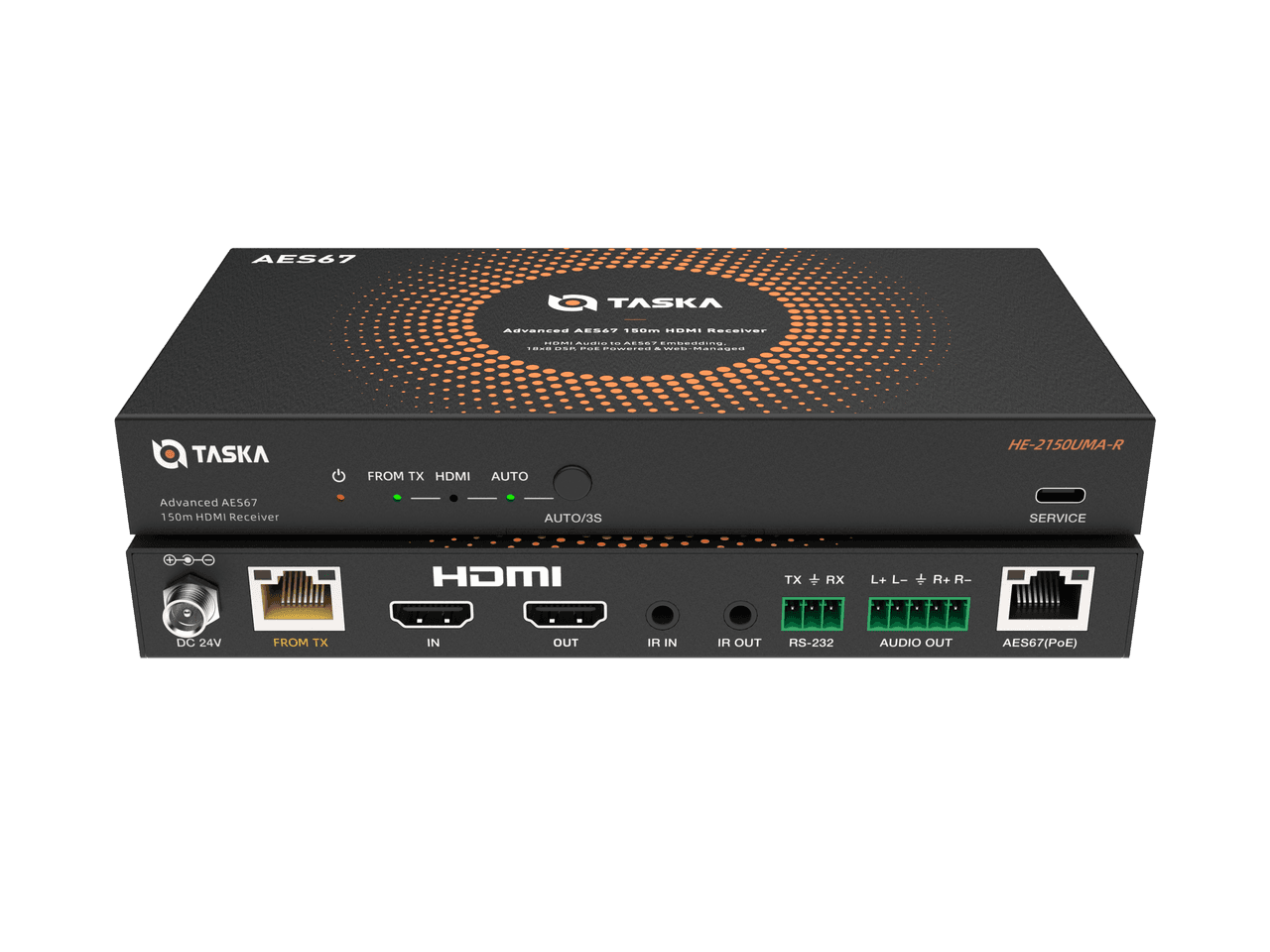
Define the audio paths first
The receiver provides 16 AES67 inputs and 8 AES67 outputs. Two additional audio inputs from the HDMI output feed the DSP alongside network audio. These channel counts describe the published audio paths; they do not mean eight additional HDMI outputs.
For a meeting-room design, identify microphone, program audio, far-end conferencing audio and destination paths. Assign clear channel labels and verify routing against the product manual.
| Path | Published capability | Design task |
|---|---|---|
| Network into DSP | 16 AES67 inputs | Map each sending device and channel |
| HDMI audio into DSP | 2 additional audio inputs from HDMI output | Identify the selected presentation/program audio path |
| DSP back to network | 8 AES67 outputs | Assign processed destinations and validate routing |
| Power | Whole receiver can use DC or PoE | Confirm the specified supply and installation power budget |
Choose processing to match the room
The semi-open DSP architecture allows processing blocks to be added according to project needs. Build the required signal chain rather than enabling every block.
AEC, AFC and ANC are available alongside feedback cancellation. Gating automixing, gain-sharing mixing and Audio Mixing support different mixing tasks. Filtering and equalization include high-pass and low-pass filters and a parametric equalizer with adjustable bands. Limiter, compressor, gain and signal generator functions complete the published block set.
Availability of a block is not a room-performance guarantee. Microphone placement, gain structure, acoustic conditions, routing and commissioning affect the result. Confirm block resource limits and the intended design with Taska.
AEC and conferencing integration
Acoustic echo cancellation needs a correctly chosen reference signal. Document the far-end and local audio paths, then check reference routing and return mixes in the supported configuration. Do not assume that adding an AEC block alone completes a conferencing design.
Keep presentation audio, local reinforcement and audio returned to the remote meeting distinguishable in the design. Test speech, double talk and source switching during commissioning, using the actual conferencing peripherals.
A conceptual meeting-room workflow
In a room with compatible AES67 audio endpoints, route the required network channels into the receiver’s DSP, process them for the project and send selected mixes back to the AES67 network. Add presentation audio through the published HDMI-to-DSP path.
This is a conceptual routing example. It does not claim compatibility with a specific microphone, loudspeaker or conferencing platform. Validate network audio formats, clocking, routing and device interoperability for the proposed installation.
Integrate control and power deliberately
A third-party control API is available. Use the current HE-2150UMA-R command list to confirm the exact controls exposed to the room controller; the availability of an API does not imply that every DSP operation is remotely accessible.
The whole receiver can be powered using DC or PoE. Keep Ethernet PoE and power over the HDMI extension link distinct in the installation drawings. Check the datasheet and supply requirements before selecting the power source. The compact enclosure still needs appropriate mounting, cable clearance and ventilation.
Commission and document the result
Start with safe gains and validate one input-to-output path at a time. Confirm AES67 clocking and network compatibility, check the HDMI audio source, then test each processing chain and control preset.
Record firmware, DSP configuration, channel mapping, reference routing, power method and recovery instructions. Use the published manual and command list for exact procedures rather than treating this guide as a replacement for product documentation.
Questions before you specify
Is HE-2150UMA-R a standalone USB BYOM gateway?
Do not specify it as a USB conferencing gateway. Its published role combines HDMI reception, AES67 audio and configurable DSP. Select separate USB/BYOM connectivity where required.
Can the hardware run from DC or PoE?
Yes. Taska confirms DC or PoE can power the whole receiver. Verify the supply requirements against the current product documentation.
Does AES67 guarantee compatibility with every Dante device?
No. Confirm whether the other endpoint supports the required AES67 mode, formats and clocking. Dante branding by itself does not validate a proposed AES67 route.
Where are exact routing and control instructions?
Use the HE-2150UMA-R datasheet, user manual and command list linked below. Ask Taska to confirm any undocumented configuration or processing limit.
Product documentation and next steps
Published product pages and their linked documentation underpin the model facts in this guide. Confirm the current model, firmware and documentation revision for your installation.